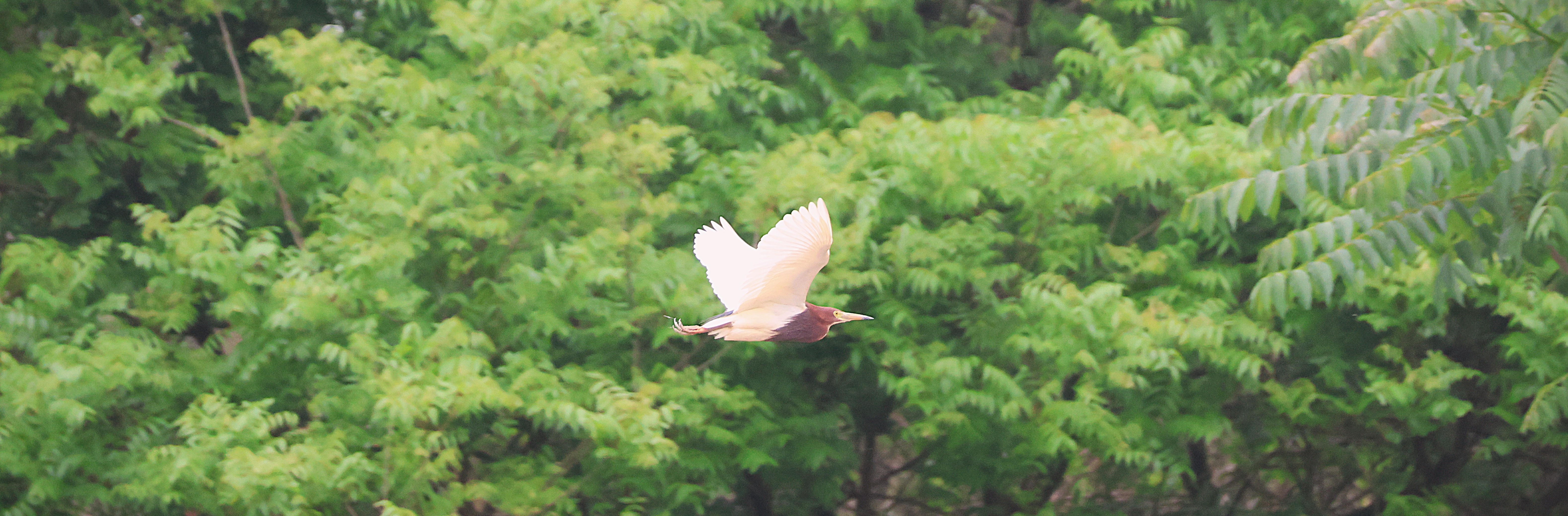
This past weekend, I made a day trip to central park to do some early spring birding. My goal for the day was to see a Winter Wren, which I not only failed to do, but every birder I spoke to also informed me that they had yet to see or hear one all year. This was a bummer, since Ebird had listed sightings in the last 7 days, but with LBB’s (little brown birds) sometimes you just have to get lucky. Hopefully I’ll catch one in the Catskills later in the year.
Anyways, failing to see a Winter Wren and with the day coming to a close, I decided to sit by Harlem Meer and try to spot some interesting waterfowl, as a passing birder earlier in the day gave me a tip that a Night Heron had been seen in the area. Harlem Meer was a great birding spot! I hadn’t been before, and a large chunk of the area was under construction which limited my access, but the whole path was lovely, and there were some unexpected Cormorants lounging in the water. The Night Heron declined to make an appearance (then again it was day time. I had hoped that breeding season might make them more active even in the afternoon, but no such luck), but something much cooler decided to drop by the lake for an afternoon snack: three American Osprey.
I was treated to a pretty spectacular display. Two of the Osprey appeared to be paired off, with the third being either an interloper on their territory, or perhaps an unmated adult that shared some of their hunting range. The paired individuals spent nearly a half hour variously harassing the third Osprey and diving into the lake for small fish. I caught this female making a catch on camera.


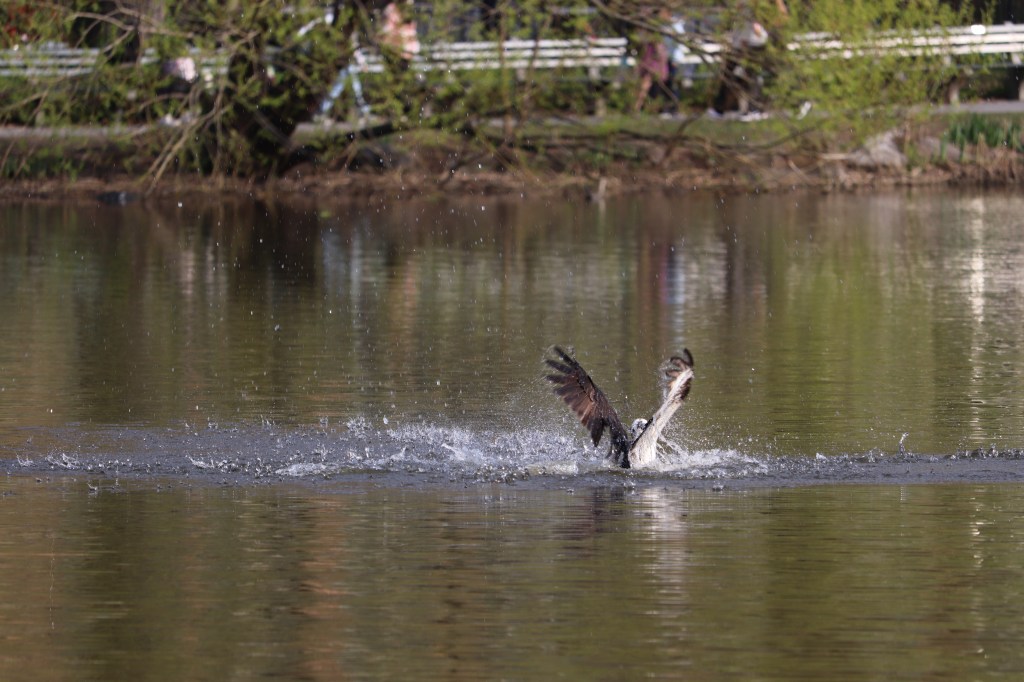

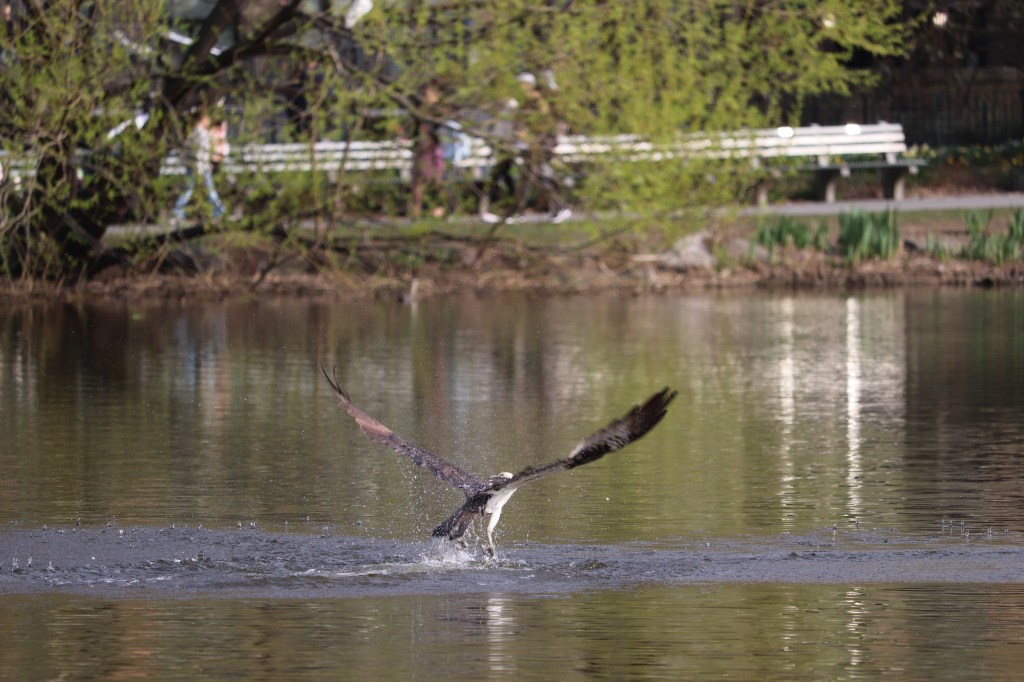
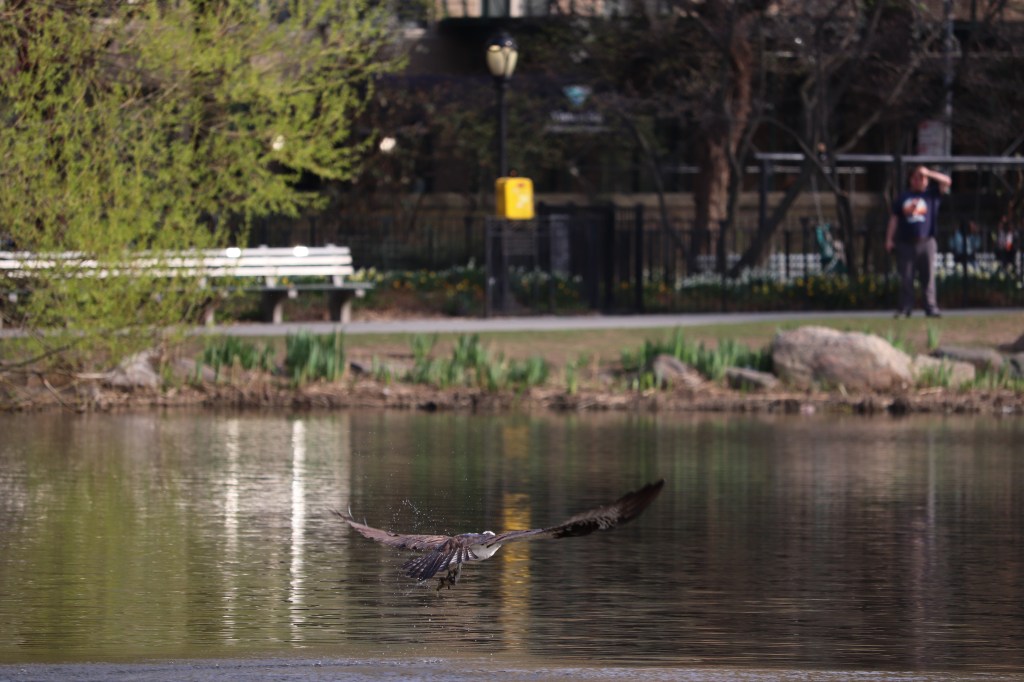


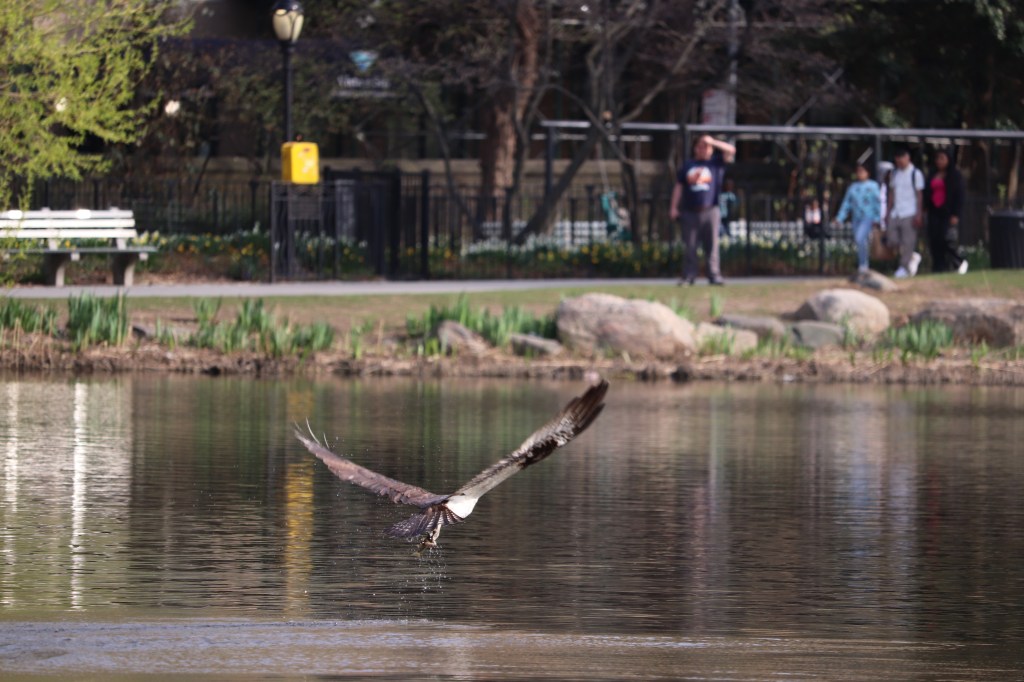
Osprey are acrobatic and energetic fliers, seeing them dive is always a treat! Even non-birders seemed fascinated, and one family approached me to ask questions about the bird’s behavior (which is always fun, personally I am always more than happy to share my hobby with passers-by).
And, honestly, Osprey are pretty fascinating birds! Their breeding and nesting habits alone are pretty unique. If you’ve ever spotted a telephone pole or cell tower with a big wooden platform, you may have noticed a large, messy birds nest piled on top. Here in the northeast, most of these nests are built by Osprey (with some small incidence of Bald eagles or other large birds of prey).
I really find this behavior fascinating, that being birds that adapt very well to human-made structures. Many large birds of prey, especially Osprey, are considered “platform nesters,” meaning that they tend to prefer nesting in the tallest available perch, especially one surrounded by lots of open, visible space. Dead trees and snags are a favorite in natural settings, as are cliff sides, where the nest is far removed from ground predators (foxes, raccoons, and even skunks will steal eggs if they can access them. Trust me, I’ve seen raccoons raiding birds nests in broad daylight), and easy to defend from aerial harassment (Eagles and Ospreys don’t tend to get along). This preference is not unique to Osprey, and many large birds of prey similarly select for isolated, platform-style nests. However, few other birds have adapted quite so readily to nesting in human structures.
Osprey are active nesters, but their preferences are highly adaptable, which perhaps is why they are so willing to utilize human-made nesting platforms even in densely populated areas. Osprey subsist almost exclusively on fish, and when nest sites are few and far between but fish are plentiful, Osprey have been known to nest as near as 30 feet to other Osprey and avoid aggressive nest guarding behavior. These birds habituate very quickly, and are more than willing to share their space with other Osprey and even humans. Today, they nest in busy suburbs, on the side of highways, and even on high-rise buildings in cities (which may be the case for the Central Park pair).
For those of you that have been reading for the last few weeks, you may recall I mentioned an extremely part time position I have been filling since my intended job bit the dust back in February. This job is not the most complicated, it’s just performing surveys on cell towers and power poles to look for nesting birds, but interestingly, in the North East, the vast majority of birds nesting on top of power poles are Osprey. I can tell you first-hand these birds are very willing to put up with human disturbance, and adapt very well to human-mediated environments. And, bonus, these birds are obligate fish eaters, and have managed to utilize stocked lakes and invasive “trash” fish species (which humans don’t want to eat) such as Snakehead and Carp. Osprey have thrived in a human-altered landscape, and today breed on every continent except Antarctica. Their range has only expanded as humans have erected towers for them to nest in and stocked lakes with fish for them to eat.

You can see the small fish in the Osprey’s talons here
Ospreys are just one of a small subset of birds that have harnessed human expansion for their own gain. Invasive species are the obvious example. I talked last time about House Sparrows, which were introduced in the 1850’s and have since spread throughout North America, while common Pigeons can be traced back to the first European colonists in the early 1600’s. All North American Starlings can be traced back to a single release of less than a hundred birds in Central Park circa 1890 by a Shakespeare enthusiast who wanted the park to contain every bird mentioned by name in Shakespeare’s plays and poems. By 1940, the Starling had made it all the way across the continent.
As it turns out, New York is a bit of a hot spot for critical miscalculations in species introduction.
But not all birds that thrive alongside humans are invasives. Barn Swallows once nested in caves and cliffsides scattered throughout North America, but as European colonists began to build large wooden structures, these birds found themselves much more suited to nesting in the eaves of buildings. You have probably seen their cup-shaped mud nests tucked in the corner of porches or inside the lettering of large signs, and today these birds nearly exclusively breed in human settlements.
Red-Tailed Hawks and Barn Owls are two predatory species that found themselves uniquely suited to exploit large-scale agriculture. Barn Owls prefer hunting “pest” rodents, especially Field Mice and Pocket Gophers. The spread of commercial farming in America has not only boosted the populations of their favorite prey, but also provided them with ideal hunting grounds; leveled grassy fields. Red-Tailed Hawks also prefer small rodent prey, species that have thrived as pests on human agriculture and habitation. These birds prefer patchy, limited woodland broken up by large open areas, the exact description of most of rural America, and as such their range has increased drastically in the last 100 years.
Human habitation is a force to be reckoned with. People are smart, tenacious, and plentiful, and we have managed to transform our ecosystem to suit our needs more effectively than any other living thing on earth ever has. But I am fascinated that even as humans have crafted a world that caters specifically to us, some other organisms have managed to carve out a niche and thrive in this brave new world. From an Osprey fishing in Central Park to Barn Swallows nesting in the eaves of a suburban house, we may be pushing the world to accommodate us, but the world will always push back. As humans tear up the landscape to remake it into something that suits us, there will always be something to pick up the scraps.
And, frankly, I just think that’s neat.

Well, that’s all from me for today. Don’t forget to appreciate your local human-adapted species, and I’ll see you again soon!


 Ornithobotanica
Leave a reply to importantc7b029c4f2 Cancel reply