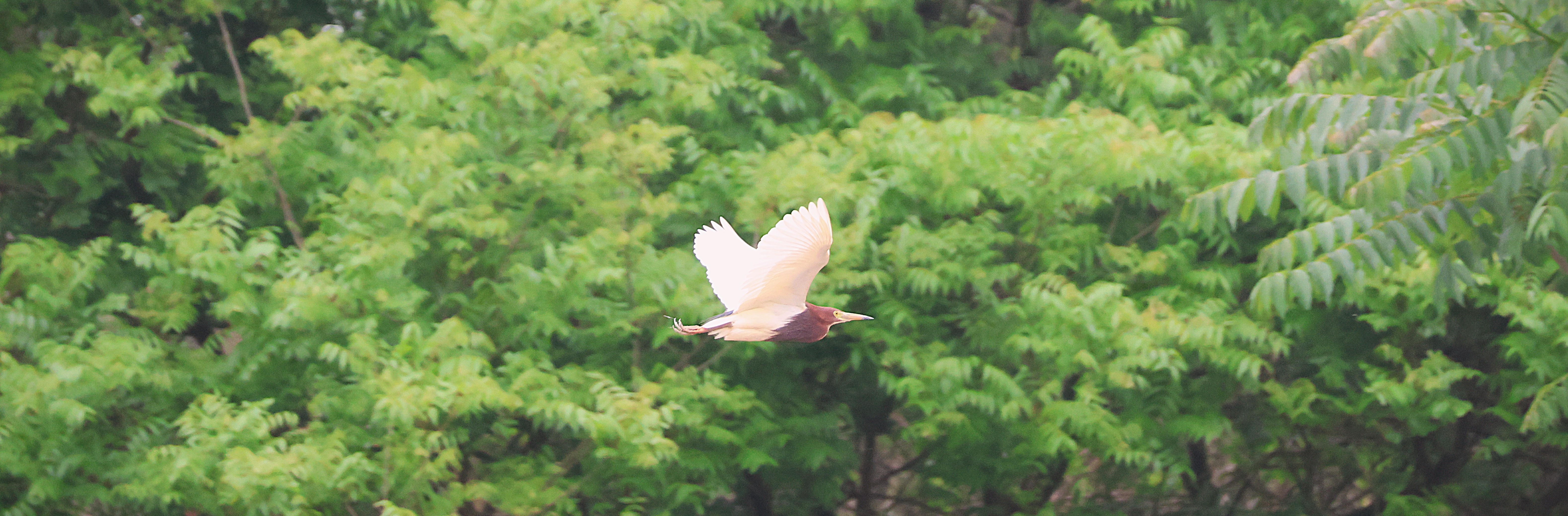

Last year, I drove from California to New York. Before my cross country road trip, I packed my life into my SUV. It was a tight fit.
Now, don’t get me wrong, I love my SUV. She’s reliable, she gets great gas mileage, she’s stylish as hell. She’s my home! But for most of this move she would also be my house, or tent, whichever you prefer, because why get a motel room when you can sleep in your stylish car?
So in this car we have me, not a small person, most of my possessions, my bed, and, big twist, my friend’s 6 year old Ball Python in his 55 Gallon terrarium (I agreed to deliver him to her in New York, which made for a very strange sleeping arrangement).
As I said, a very tight fit.
So when, as I’m preparing to leave, my mom waves me back and tells me she has a gift for me, I was honestly a little worried that whatever it was simply wouldn’t fit in the car. My mom, though, came back to the driveway with a gift bag and asked me to open it. Inside was an AI bird feeder.
On an entirely practical level, this is a very silly thing to own, much less transfer several thousand miles to the other side of the country. On an emotional level, though, I can’t deny a bird feeder that ID’s and takes pictures of birds automatically may be the raddest thing I’ve ever seen. I thanked my mom for the gift, threw my 5 gallon water jug in the trash, and brought the bird feeder and feed bag with me instead.
Did I second-guess this decision in the middle of the Arizona desert when I had to brush my teeth dry and spend a half hour the next morning locating a gas station to stock up on 8 ounce water bottles that could fit in my center console? Quite possibly (but I would never admit as much).
You may be surprised to hear this from a birder (which is a hobby best accomplished in remote areas in the early dawn) but I am naturally quite lazy. I love nature and hiking, but I also love to relax. If I can combine the two and take a nap in nature, that’s basically my ideal afternoon. I’m not ashamed to say, even as someone who has birded on 5 continents, that I rarely enjoy the hobby more than when I do it in my backyard. Backyard birding is fantastic! It’s accessible, for one, anyone with the ability to step out of their house can bird, even in cities (trust me I’ve seen some impressive diversity even in NYC). For two it lets me appreciate nature from the comfort of a lawn chair. As much as I love backpacking and extreme hiking, very little beats a lawn chair in your own backyard. In college I would bird out of my first floor dorm window, or laying in the Quad between classes. In my apartment I would pitch a chair or blanket in the communal yard and bird there. The day I discovered the Merlin sound ID app (by which I mean to say my mom discovered the app and showed it to me. Thanks for the second time today mom), which listens to bird songs and suggests ID’s based on both the waveform of the sound and likely birds in your location, my life was forever changed. My skill as a birder improved DRASTICALLY via this app, and most of it happened in my own backyard.
All this to say, I love convenience. I love relaxing on my couch, and I love birding! An AI bird feeder is right up my alley.
Unfortunately, AI is not great at identifying birds.
Look, don’t get me wrong, I love the bird feeder. I love any bird feeder, for one. I don’t care how good of a birder you are or how habituated the birds in your area are, you will almost never get closer to a bird than you will to a bird at a feeder. Bird feeders are cool, being close to birds is cool, full stop.
And putting a camera in a bird feeder is honestly a great idea. And this thing has taken some VERY cool pictures
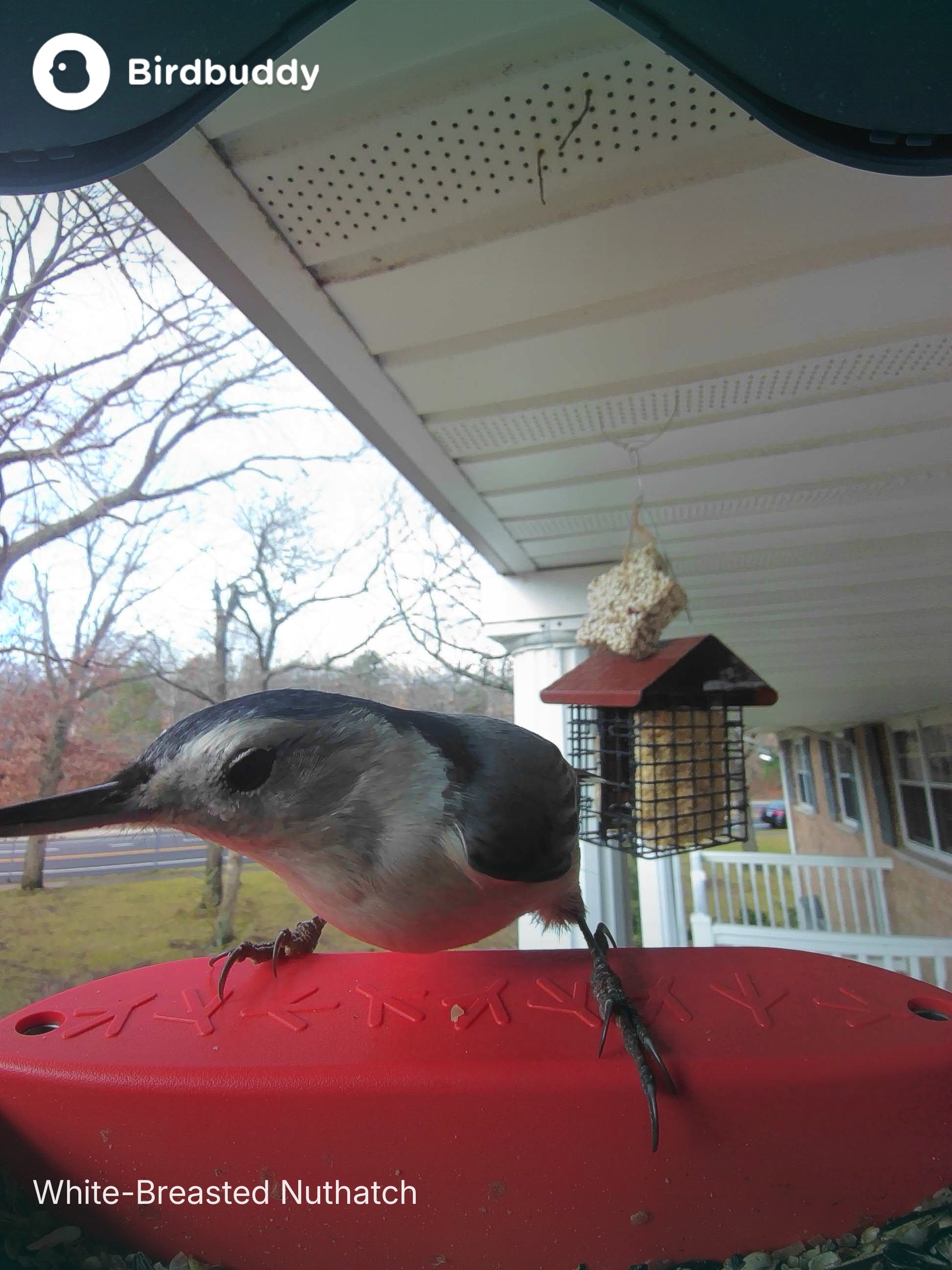


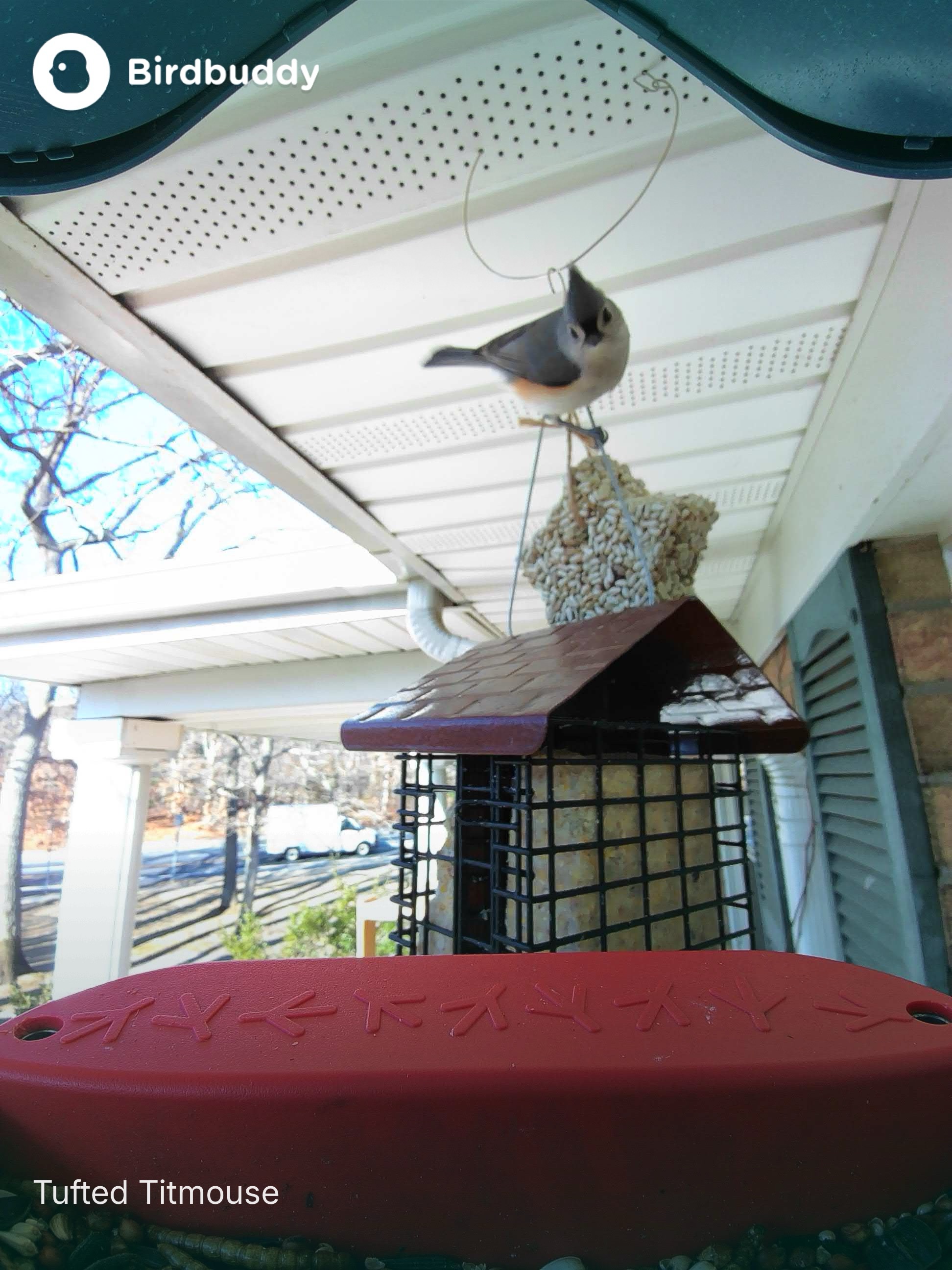
A sample of some of my favorite native visitors to my bird feeder. That nuthatch and titmouse are two frequent flyers, and tend to perch on my kitchen window to snack.
But it also takes a LOT of pictures of house sparrows. Like a LOT. To the point that I suspect it just isn’t very good at recognizing that a bird is in the feeder if it ISN’T a House Sparrow, because when I actually look at the feeder, it’s attracting a lot more than just America’s most prolific invasive bird.
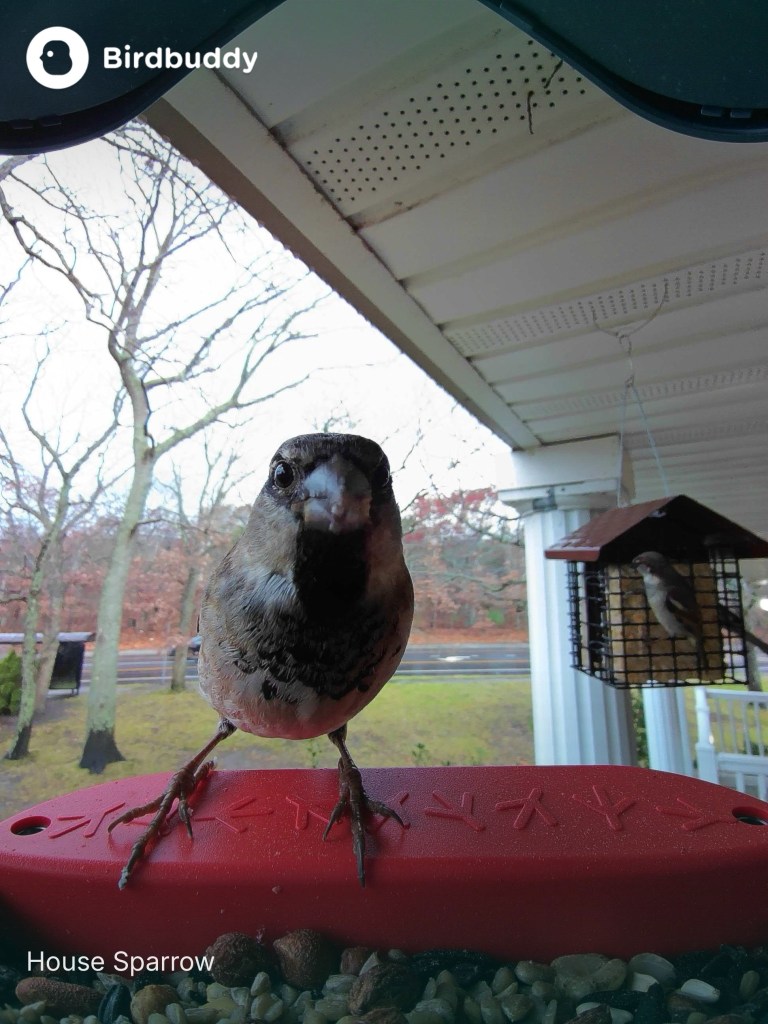
The aforementioned house sparrow, caught in the act . These bad boys are not too discriminating with their food preferences, so even the feed mixes that other species avoid will attract hordes of House Sparrows.
If you don’t already know House Sparrows are highly invasive, African native birds that were introduced to America in the mid 1800’s. In fact, they were specifically introduced right here on Long Island in 1852 for the express purpose of controlling pest moth populations. Ostensibly the Sparrows did a mediocre job at moth control, but a stupendous job of expanding into their new continent, and quickly established themselves everywhere from Brooklyn to the Rocky Mountains in a mere 50 years. Today House Sparrows are a human-associated invasive pest on every continent but Antarctica (though I wouldn’t be surprised if that changed any day now). House Sparrows are pretty terrible for the environments they invade, but there’s a lot to love about these little birds. They’re active, charismatic, social, and very quick to habituate to human presence. One of my earliest bird-related memories is walking through San Francisco as a child and having the wild House Sparrows land on my arms to eat cookie crumbs from my hands. As an invader, these birds are pretty ferocious, but they’re also adorable and honestly, I like them (don’t tell anyone they will revoke my biologist licence).
This ubiquity, however, informs my own pet AI theory: AI is simply better at identifying widespread invasive species than natives.
This is just an assumption, obviously, but I have noticed a very strong trend with my AI feeder that mirrors a trend I’ve noticed in my beloved Merlin ID app, which is that the technology tends to over-represent the incidence of common, often invasive species simply because it is much better at identifying them. Many times I’ve pulled out my Merlin app to record a chorus of birds and it has failed to ID anything beyond House Sparrows and Starlings (not always, obviously, and not exclusively, or I would probably love the app a lot less than I do), and my bird feeder seems to suffer from the same pitfalls. Easily, 90% of the ID’s I get are for House Sparrows, despite them being more like 60% of my actual bird population.
I have some theories as to why this is. This particular bird feeder allows users to rate its identifications, and to edit them if they are wrong. It’s possible that most users are simply better at identifying House Sparrows, since few native birds look like them, and are therefore more likely to rate or edit posts about House Sparrows. Perhaps there is more data about House Sparrows in the collective database on which this (and by extension the Merlin ID app) are trained, and so they become disproportionately better at noticing these species. Merlin specifically clearly relies on a limited database, which you may not notice when using the app in the US, but becomes VERY apparent birding in continents other than North America or Europe, where the app returns very few ID’s and actually warns you that it has limited data for your georegion. Tragically, Merlin was effectively useless during my tenure in China.
The knock on effect of this is that I may be sitting at my breakfast table, sipping tea and watching birds come to the feeder, and spot 8 or 10 species, then check my bird feeder app to find 15 (admittedly adorable) pictures of House Sparrows and nothing else.

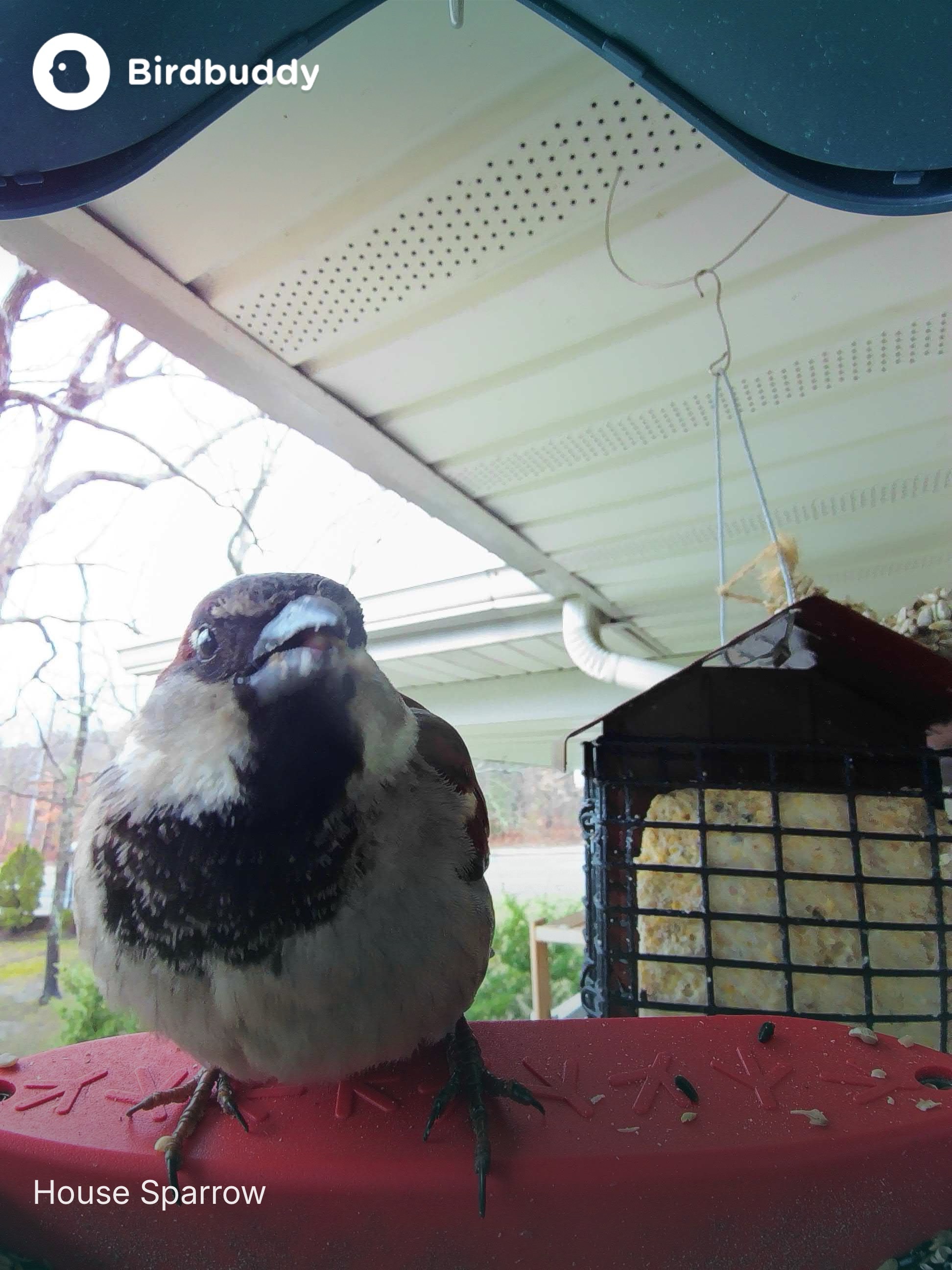
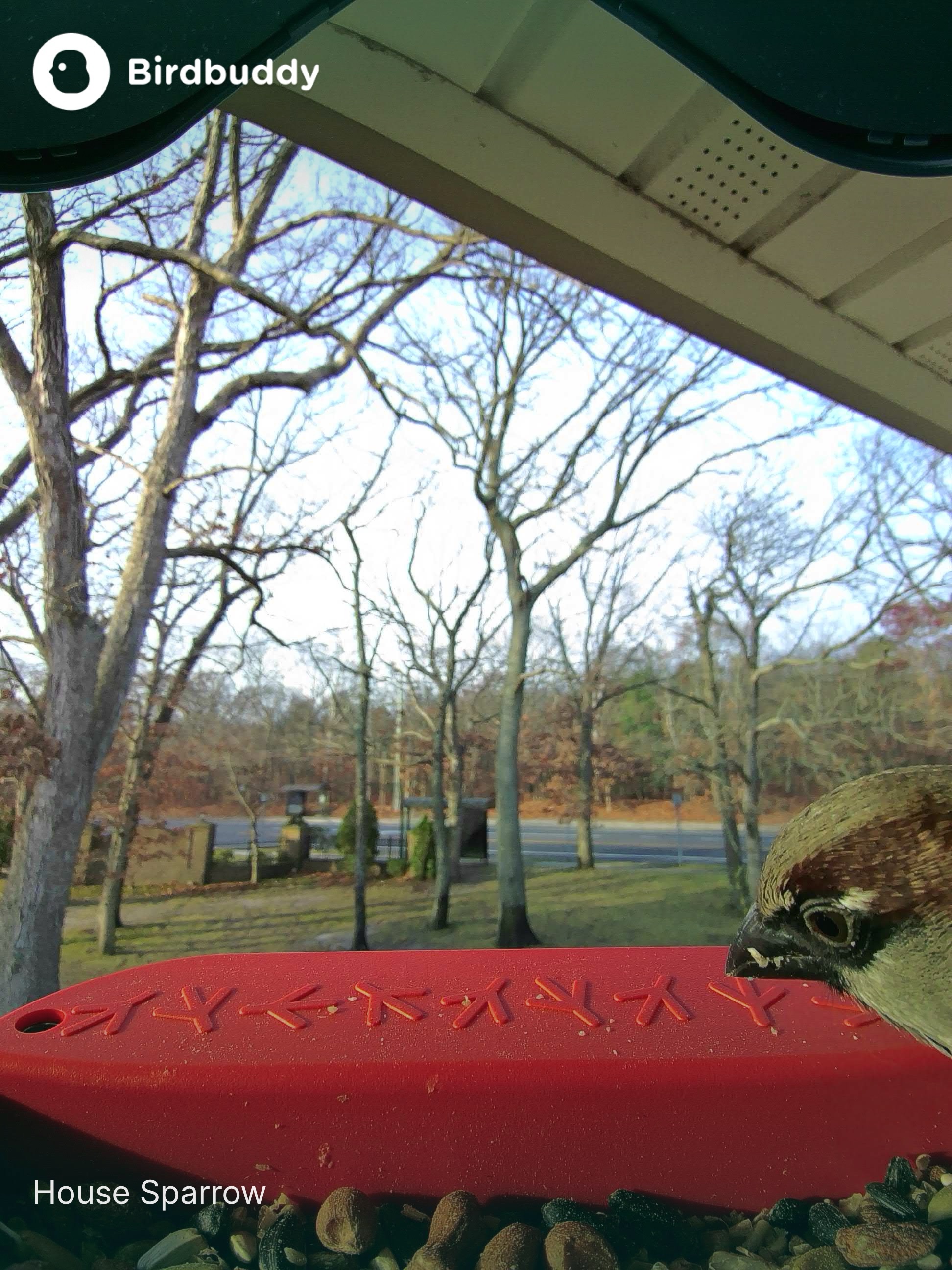
If I’m lucky, perhaps a particularly cute video.
It’s interesting to me where and when these AI tools start to break down, and try to hypothesize why. On a smaller but no less interesting scale, I’ve noticed my AI feeder wrongly ID’s a House Sparrow as a Brown-headed Cowbird about 1 in 40 instances, for which I have no explanation and cannot even hazard a guess.
So, what’s the takeaway here?
Well, for one, my mom is a pretty awesome gift giver. Everyone give due credit to my mom for being an early technology adopter.
For another, birding tech is all in all, pretty cool. Anything that makes the hobbies I love more accessible and easier to share with my friends is always a plus in my book, and silly fish-eye-lens photos of birds at my feeder have been VERY popular in my various group chats with my non-birding brethren. My feeder may only get a picture of every hundredth White-breasted Nuthatch that visits but that picture is universally pretty cute, and every picture helps me learn more about the behavior and habits of my neighborhood birds. Merlin sound ID, too, may not be perfect, but I can confidently say it has substantially improved my audio ID skills, and is probably my favorite non-social media app.
But, much like birding from your living room window, these tools are limited. AI is simply not capable of providing an accurate sample of the birds in your area, be it from a feeder or from your phone. And frankly, birding exclusively from a feeder is, itself, pretty limiting. Certain birds simply don’t approach feeders. Some are skittish, some don’t prefer the kind of food available in commercial bird seed mixes, and some are intimidated by other, larger birds. I am a lazy person, I love birding from my couch or lawn chair, but I do, occasionally, have to get out of my chair if I want to see every bird my local ecosystem has to offer.
So for all the other lazy birders and nature lovers out there; don’t be afraid to enjoy nature from your home! Backyard or kitchen window birding may not tell you everything there is to know about your local birds, but that doesn’t mean there isn’t a lot to learn from the comfort of a familiar perch. (Non-AI) Bird feeders are cheap and fun, and watching a bird while you eat lunch is, as far as I’m concerned, more engaging and educational than most other things you could do. If you are thinking about getting an AI bird feeder, I can tell you they are pretty dang cool! A feeder may not guarantee you see every bird in the neighborhood, but it does mean the birds you do see will be up close and personal.
Keep kicking back, relaxing, and enjoying the nature in your own backyard. Power to the lazy nature lovers among us!

Be like the humble carolina wren lounging on the bird feeder during golden hour: looking good and feeling even better.
Anyways, thanks for joining me in this little ramble, and I’ll see you again soon!


Leave a Reply